Improving my mousetrap
So I built this little hobby blog engine and had a good time with it, but one of its limitations as a writing tool was that it required me to sit down with the laptop to actually publish: Although the whole thing lives in a Dropbox folder, I needed my trusty MacBook Pro to run the Ruby to build and then deploy the site to my web server. I could write at the coffee shop on my iPad or iPhone with my favorite Dropbox-compatible tools (like iA Writer), but couldn’t publish directly from iOS.
Until now. A couple of weeks ago I tested out the Ruby engine itself on my server at TextDrive and found that it worked with just a couple of small modifications. But my content still lived in Dropbox. How would I bridge the Dropbox-server divide?
Enter mover.io, my new favorite technology crush. Its API lets me download from Dropbox directly to my server. I repeat, it’s awesome. So here’s the toolchain: Write in iOS, hop into Prompt to run the deploy script on the server, and boom, published blog goodness.
I started and finished this very post, zapped it to my server and ran the build, checked its rendering and then deployed to production – sounds fancy, right? – all from my iPhone. It’s pretty much the new hotness for me.
I’ll write up some of the technical details later. This was lots of fun to learn, and I have more cool ideas for putting mover.io to use.
- My first modem was a 1200bps Everex, a Christmas gift from my uncle when I was in the fifth grade. My connectivity progression after that was to 2400 (oddly, I don’t remember this brand; it was an internal, I installed it myself, and I had to fiddle with jumpers. Now it’s really bothering me that I don’t remember the model), 14.4 (Supra, ca 1992), 28.8 (Supra, ca 1994), a mix of ethernet and 28.8 through the remainder of college, then 56k (USR and others) circa 1998, until landing with cable in 2002-ish.
- I was already into computers in the fifth grade, but it’s fair to say that that first modem substantially shaped the course of the rest of my life.
- My freshman college dorm was a converted house, about half empty, and we ran long phone cords from empty rooms, through windows and up stairwells, to plug into our modems and play multiplayer Doom. Hot stuff. Not a lot of girls visited that dorm, as it was on the far end of campus.
- The first multiplayer, non-BBS door game, that I recall playing was Modem Wars. I loved that game.
- I also loved Wing Commander. The cinematic sequences and music were a revelation. I had an Ad-Lib card and a huge expansion card full of 4MB of RAM that I installed in a Compaq DeskPro 386sx/16. As they described on the podcast, I had to swap
config.sysfiles to turn on expanded memory when I wanted to play. The Compaq had heavy, loud power switches. - I got Wing Commander as a Christmas gift. I had asked for some nonsense called Tunnels of Armageddon. Man am I glad the Software Plus guy steered my mom and dad away from that one.
- Playing games meant I had to shut down the WWIV BBS that I ran throughout high school.
- My first PC was an IBM PC.
- First “laptop” was an Everex Tempo, I think a 286. I used to run Turbo C on it to mod and compile the BBS. It was a small tank, and I took it to study abroad in Rome in 1997. Later I took it to grad school and it was stolen from my crappy rental house in 2000. I wish I still had it; it had a ton of text files on it and contained basically the history of my computer use up to that time.
- Good lord did I ever spend a lot of time trying to get a PCMCIA wifi card working on linux.
- Troubleshooting SCSI CD-ROM drives was a nightmare.
- I brought a DX4/100 to college. It was the fastest thing in the house, but also the most temperamental (see above).
- Post by email
- Password protection of entire site, without user accounts or user-specific logins
- Support for video
- Easy presentation of photo galleries
From the Pinboard Files
The internet has been full of interesting things to read and think on, lately. Here are a few of my favorites from recent bookmarks.
Day One Uses
The Day One folks keep a nice list of applications to which they and others are putting the tool. I don’t write as much as I think I should, but I have been trying to put at least a photo every couple-few days into my Day One journal. Additionally, I use Slogger to record twitter, app.net, fitbit, and last.fm activity.
Howell Creek Radio: Quarters
My friend Joel has a fine podcast about thinking about things and writing about things – among other things. This short meditation on found and stolen moments really got me.
Felix Salmon on the Bitcoin Bubble
In a previous career I was an academic, and I studied the project of local currencies in the United States. Bitcoin shares a lot with local currencies, but departs significantly in implementation, not the least of which is its speculative nature – which was at the core of this week’s over-the-cliff drop in value.
NRA: God Bless You, Dr. Rosenzweig
I’ve been reading Slacktivist for years, and its author, Fred Clark, is consistently one of the most thoughtful writers around. His long-term opus, a walkthrough annotation of the Left Behind series, is a deep exploration of his faith and the departures from it taken by a paranoid religious right (among others). He’s also funny and frequently moving, and enjoys Buffy the Vampire Slayer. What alicublog is for the culture wars, Slacktivist is for excoriating the nonsense prophets of the right.
Dwarf Fortress
Casey Johnston spends some time with Dwarf Fortress:
I went into Dwarf Fortress knowing the barrier to entry was dizzyingly high, but I consider (or considered) problem-solving, iterative experimentation, and quick learning to be among my personal strengths. In Dwarf Fortress, I feel like I’m trying to build a skyscraper by banging two rocks together.
I’d like to think I’m not the problem here. Dwarf Fortress wants to be understood about as much as the average teenager. The more it confuses you, the more accomplished it feels. Perhaps that’s too harsh an assessment. It is possible to tinker, after all. But tinkering is endless instead of productive, and there are so many ways to go wrong.
The depth of narrative that some players find in their games of Dwarf Fortress is seriously intriguing, but every time I think “Hey, maybe I’ll try it”, I read something like Casey’s great write-up. It’s not a game that rewards “hey, maybe” players.
Notch fitness visualizations
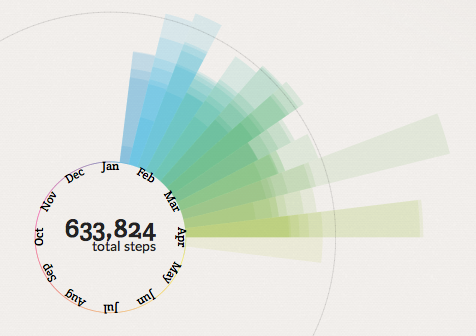
Notch provides a pretty slick and fun set of visualizations based on data from fitbit and/or runkeeper. Right now they’re focused on some fun run graphics, but I’m not much of a runner, so I’m hoping for some good bike ride visualizations in the future. Here’s a snapshot of the “Kodachrome” steps calendar.
Milestones
I’ve alluded a few times to project at work gaining steam. We recently completed it, a big one, one I’ve been working on for nearly two years but that has been on the roadmap for my team for a very long time – since well before I was on the team at all. Feels good to have completed it, even this first phase of it with much left to do. Check that, it feels tremendous.
Big milestones like that seem far apart for me, but they come every day for our toddler. Our little guy is still pre-pre-school, but his wonderful school is part of the school district, so he has long holiday breaks at Christmas, springtime, and summer (mercifully, they offer a summer session so we only need to plan for a couple of weeks of true summer vacation). Today we wrap up the latest, a week of spring break, and it seems like he’s turned a corner, learned something new, or otherwise astonished us nearly every day.
Computing memories
The recent discussion of retro gaming on Accidental Tech Podcast was an enjoyable trip through many years of my own gaming and computing history. I do sometimes imagine Siracusa (I think he and I are roughly in the same college cohort) wondering how he got paired with these know-it-all youngsters whose first computer was a 486.
In no particular order, here are a few of the memories sparked by their conversation:
Good times.
Posthaven open for business
Several months ago I spent some time looking into alternatives to Posterous for a private family blog that I use mostly to share stories, photos and videos of my toddler. At the time this search was driven by the desire to use a paid platform, rather than a free one, in line with my goal of using services whose business model is based on making money rather than “monetizing” users. Nothing quite met my needs, and the transition was not imperative, so I let the search fade amid plenty of other things to keep me busy.
With the recent announcement of the closure of Posterous by twitter, I started looking again. Turns out that what Posterous does, it does very well, its strengths line up quit well with my requirements for a family-blog, and most of the alternatives are not a very good match.
Here’s what Posterous does well:
I’m quite happy to be able to say that, as of my import to it this morning, Posthaven accomplishes three of the four of those strengths – no surprise, of course, as Posthaven is meant specifically as a sustainable (ie non-free) refuge for Posterous users.
Posthaven is open for business but not quite 100%: you can import multimedia posts (and my galleries and video came over flawlessly, unlike with any other premium service that I tried, Squarespace I’m looking pointedly at you, here) but not yet create them; post by email is not yet there; and a post I wrote up using Safari on the iPad didn’t format paragraphs correctly, instead flowing everything into a single one that I had to re-edit once I got back to my MacBook. But custom domains work great and site-wide privacy from launch is exactly what I needed out of the gate. I think it’s going to be a great replacement and I wish them lots of success, so that I don’t have to go looking again.
Update March 19, 2013: The posthaven post interface now includes an ‘upload images’ button, so creating media posts now seems to be available.
Winter, no, spring
Springtime in my southwest mountain town, a foot of snow on Friday – commerce and schools come to a screeching halt, but not before I put in most of a great work day on a new system – brilliant sunny sky today. We went sledding this morning, and this afternoon the entire world is melting, streets clearing and dry pavement showing through in many places. Beautiful.
Excel is Complex, Untestable and Everywhere
But while Excel the program is reasonably robust, the spreadsheets that people create with Excel are incredibly fragile. There is no way to trace where your data come from, there’s no audit trail (so you can overtype numbers and not know it), and there’s no easy way to test spreadsheets, for starters. The biggest problem is that anyone can create Excel spreadsheets—badly. Because it’s so easy to use, the creation of even important spreadsheets is not restricted to people who understand programming and do it in a methodical, well-documented way.
When traders pose for press photos it’s always in front of wildly-sophisticated looking visualizations, but the secret layer of MS Excel-based analysis puts the lie to that pretension of rigor.
Quiet
I came out to my refuge coffee + book shop as I sometimes do on afternoons when the toddler is asleep or occupied enough that he and his mom won’t need me for a little while. Yesterday it was a snow storm that turned into a whiteout on my short drive. I thought to read and write and do productive non-work creative things, but found I mostly watched the snow fall, with my mind quiet. It was quite fine.