Wintertime
Just a week or so ago, it looked like we might not see much winter, and suddenly here it is.

The arrival of our first snow was followed by a another weekend storm, and there is more expected overnight and into tomorrow. As I type, the wind and snow is picking up outside this cozy room where I sit next to my toddler, he with his milk and cereal, watching a few short Thomas the Train episodes after school. “There’s Percy,” he notes between enthusastic bites of Cheerios. “And Thomas has blue wheels.”
We spent a lot of time this weekend staying close to our little boy, learning more about Newtown, Connecticut, and thinking of the families who won’t tuck in their children again, won’t hear their voices, will only imagine the span of their lives. I can’t imagine any kind of words that could begin to represent such a loss, nor can I begin to understand what could motivate the shootings. Finally, I cannot conceive of a reality in which the answer to these murders is more guns.
- Star Wars Snowflakes 2012 are awesome
- Wildfires tab, a simple, elegant Josh Ritter track.
- Adobe Edge Fonts Preview tool is a good way to get a handle on options available in this typekit-partnered web typefaces tool.
- Railyard Studios makes furniture from recycled railroad track and ties. It’s beautiful stuff.
- The new book options in my town consist of Barnes and Noble and Amazon, but we have a fantastic, unparalleled and world-class used bookstore. The shop also has a great coffee shop I regularly visit for weekend downtime. Whenever possible, I am happy to buy there. I love to support this place, and it’s a core community institution, but the used book market being what it is, they don’t always have what I’m looking for.
- E-books offer instant gratification. This probably isn’t a good thing, fundamentally, but it makes me fleetingly happy.
- I like reading on the iPad. The book goes everywhere I go, it’s easy to capture notes, and I always have plenty to read, whether it’s on the iPhone or iPad
- I also like reading paper books.
- Paper books are part of an ecosystem of reading, sharing, trading and re-selling that e-books are not – and by design, due to digital rights restrictions.
- Paper books are visible on the shelf the way e-books never are, which appeals to the recovering academic in me as well as the eager reader who picked up Ray Bradbury, Isaac Asimov and Annapurna from my dad’s bookshelf. Will e-books motivate my own son to read in anything like the same way?
- At least as currently “managed” for digital rights, e-books don’t allow me to trade them at that fantastic local shop, or to lend them beyond the narrow parameters allowed by the different publishers and reader software. They are quite effectively closed to conversation, discovery, and re-use.
- E-books can’t get lost in a box, left in a coffee shop or destroyed by a spill (though the more-expensive iPad certainly might).
- Were I still an academic, e-books might aid note-taking and writing substantially over paper: Copying passages for quoting, managing references, and finding notes or noted excerpts.
- Typography on e-books is getting there, but just can’t reproduce the effect of a well-typeset book on nice paper. The recent support of some comics and graphic novels by Amazon’s kindle & app has greatly expanded the world of e-reading for me, too.
- Books require paper, ink, manufacturing, trucking, warehouse space, a whole supply chain. Are e-books with their reliance on cloud datacenters more sustainable, or ultimately, in the long run, less so? I’m not sure how to reconcile the two different kinds of costs.
- The selection of e-books available from my local public library is awful, but the web site for the e-book borrowing is even worse. It’s really truly terrible.
This week's notes
TextDrive Migration
I wrote a bit about the TextDrive re-birth a couple of months back, and last week I got my ticket to my new server. Over the course of several pretty happy evenings I completed the bit-by-bit migration of a couple of active and several mostly-defunct domains, back to TextDrive. This feels good, but there are some bumps in the road over there. I think due to the volume of new account setup, the TxD folks are having trouble providing support to users encountering problems, and there appears to be some inconsistency among server configurations.
For me this has all been mostly okay. I’m happy to be on a shiny new box and my hosting needs are pretty light these days, anyway. But for what it’s worth, the migration I did was straightforward and basically problem-free.
Privilege
Tom Morris writes on Geeks and Privilege.
The reason we’re seeing such vicious anti-equality bullshit in the geek community over the BritRuby situation and other conference type stuff is because the very existence of societal inequalities (against women, racial minorities, gender/sexual minorities) threatens the whole idea that hackers got where they are because they are super-fucking-smart.
It’s a smart piece, well worth the read and certainly worth thinking about at more length.
GTD
I spent some time in grad school really tuning a Getting Things Done workflow. I contributed a bunch to the TextMate GTDAlt Bundle and was pretty dialed in for a while. I used it right up until the time I made a career shift post-PhD and lost the handle on my workflow in the transition. Last spring, among a pile of increasingly-complicated work, I picked up the emacs habit again in order to use org-mode and organize my activity and the huge volume of notes I was making.
Doing a more organized effort at GTD didn’t really seriously occur to me, though org-mode has worked very well as a part of that workflow, namely a good collection bit via its capture/remember functionality. Then I started listening to the recent Back to Work episodes on GTD, and have been giving a more official system a bit more thought. I don’t honestly know if the contexts thing works for me anymore, partly because that particular element seems so oriented towards the tools, but the conscientious approach of “what can I do now to advance a project” really appeals to me. If nothing else, a good appraisal of how I’m working should be a useful exercise.
From the Pinboard list
A few more things I’ve noted lately:
Rdio, Access & Ownership
Rdio got a lot of play this week with the launch of version 2 of its mobile app. Like Federico Viticci, I have always preferred Rdio’s orientation to albums and collections to Spotify’s playlist-centered organization, and Rdio. I’ve used and enjoyed it for a year or so now, though my listening time has decreased in the past months as I’ve listened to podcasts more, and the new release has prompted me to clean up some dormant playlists and crufty to-play queue. I’m intrigued by the syncing between the mobile and desktop app, and wonder if it’s a route to sending music to AirPlay speakers or the AppleTV (natively, rather than through AirFoil, which does work but feels fiddly) – but, in a first attempt, the mobile app doesn’t play successfully via AirPlay at all, just reverts to the local speaker every time I try. So that may be a step back, though otherwise the update is really nice, visually and functionally.
I do wish Rdio had a “favorite” action that could push to last.fm. As-is, I have a sort of favorites playlist that is easy enough to add tracks to, and while this helps keep track of things I like, it doesn’t quite push the button in the same way.
In another discussion of Rdio, Shawn Blanc notes that it has fully replaced his regular music purchases. It largely has for me, too; previously I happily subscribed to eMusic for about five years before trying them both together for maybe six months. The long term trend in my eMusic usage was basically that I wasn’t using it much – I was wasting my download credits – in part because at the time I was using a Droid X, and syncing my iTunes library was just a lot of work, so the collection match and streaming to mobile in Rdio was a big bonus.
But Rob Weychert’s thoughts on Rdio (via Shawn’s post) nicely makes an observation on the converse:
Rather than investing in one album, I’ve invested in all the albums, which is the same as investing in none of them. If something doesn’t grab me right away, I don’t have an incentive to return to it, which limits my repeat exposure to only the music with the most superficial rewards. And even that stuff is quickly overcome by the newer and shinier stuff constantly spraying from Rdio’s fire hose.
In addition to being a wonderfully data-driven consideration of his use of the service, I think this is insightful and reflects the downside of the otherwise-very-appealing-and-resonant “access, not ownership” theme. So lately, when I really like an album, I buy it outright. Whatever streaming service is around in a few years can’t terminate that license and take the CD off my shelf; meanwhile I can actually see and rediscover (some of) my collection of music and be thereby prompted to perhaps reward myself by listening to it.
Seasonality

The onset of December is an entirely expected, predictable phenomenon that has taken me by surprise and fully unprepared. Perhaps it feels like it caught me without warning because it has been so unseasonably warm here: After a sharp cold snap, most of October through November was warm and dry, and no real winter weather is in the forecast yet. The leaves have turned, and there’s frost in the mornings, enough to make the lawn feel a little crunchy, but daytime temperatures of 55+ degrees F have kept me from fully realizing the turn.
Still, the nights are coming earlier and earlier, and tonight’s sunset with a few high clouds was a treat.
Howell Creek Radio
On the subject of seasons, the most recent episode of the Howell Creek Radio podcast, Snap, is a characteristically well-delivered medidation, this one on what sounds like a dark and cold season Joel is quite happy to have left in his past. Joel is a writer and thinker whom I greatly enjoyed meeting a few months ago when he passed through town and I recommend checking out his (handsome) creations.
e-book Ambivalence
I’m ambivalent about e-books. (eBooks? E-Books? Electronic books? Too branded, too formal, and too anachronistic, respectively. I’ll use “e-books” for now, though I don’t much like it, either.) Mostly unsorted and partially thought out, these are a few reasons why.
The future I imagine is one much like the state of music downloads that Apple precipitated with iTunes Plus – DRM-free media readable by any supporting application or device (though the book industry is so strongly committed to its DRM that I’m not holding my breath). In the meantime, one of the conditions that persists is having my reading distributed across physical books and several electronic platforms. This, by the way, is one of the things that continues to make me fussy about the state of all my media, and the separation between these platforms only exacerbates the problem of sharing and finding (also, enjoying) when one’s collection is a mix of digital and physical media (“media” – what an awfully impersonal way to describe the albums and books that I love and that carried me through the highs and lows of life so far).
And the Incomparable does e-books the next day
I put up this post and then, the next morning, put on the Incomparable podcast on e-books in the car on the way to toddler drop-off and work. What a great conversation, and not just for the gratifying agreement that the monster-truck-rally-sounding “Overdrive” e-book lending system is a disaster.
James Gowans on Using What You've Got
What if you could eliminate a lot of the friction you might feel when trying out new apps and then deciding on which to use? What if you could save the time you might spend tinkering with third-party apps and their settings?
So two weeks ago, I started this experiment: I’ve reset my iPhone and iPad both back to factory settings, and I’m trying to almost exclusively use the stock iOS apps.
I really like this, and I love the results of his experiment: He’s become very good at using the built-into-iOS tools for taking notes, syncing, launching, and finding.
Reading
Catching up on some reading, I pulled out The Magazine while waiting for my lunch date earlier this week, and read two of the best short pieces in a very long time: Gina Trapani’s How to Make a Baby and Stephen Hackett’s Parenting Technology. Both are moving, sharply-written – and one is terrifying – essays on the role of technology in creating and sustaining the lives of the authors’ children. I have to admit that the first few pieces I read in The Magazine sort of left me cold; they didn’t seem quite developed enough, like draft blog posts that did not deliver, perhaps on tone or perhaps by strong buildup with too little room or time for a satisfying conclusion. But as editorial vision and guidance starts to ramp up, the way it seems to be doing now the articles are getting better and better. These two pieces are as good as anything else out there, and I hope strong editorial work will continue to combine with talented writers to craft a very good publication.
The Magazine has also generated a lot of attendant commentary about writing and publishing. Glenn Fleishman on The Talk Show this week noted something I thought was particularly interesting, that he and Marco Arment have a serious strategic puzzle to consider as they continue to develop it: They want to publish as much good content as they can manage; but if they can sustain it on a weekly pace (as alternative to the current biweekly schedule), would it overwhelm readers who already have plenty enough to read on a biweekly basis, or would it foster more readership by providing more opportunity for a broader set of readers to find something they’re interested in?
Now, thanks to Marco and Co., I have two sources of too much reading, both of which I look forward to opening up.
I built a toy
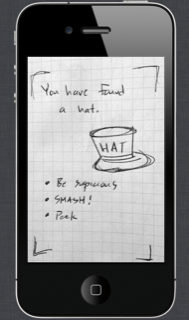
The POP - Prototyping on Paper app is pretty cool: It’s really built for wireframe designs of iOS applications: Take pictures of your designs, load them into the app, and mark them up with hotspots that link to other pages of the wireframe or mockup. Seems like a neat idea, if you’re an app developer.
I’m not a developer, but I have a notebook and like to scribble, so I used it to make a tiny choose-your-own adventure story: Hatventure:
You can play it right in your browser, and it looks a little better on a mobile screen. I don’t think there’s a way to share it to the actual app, where it definitely feels a little more native.
It was fun, and maybe you’ll think it’s fun, too. I’d love to see other, non-app-development-based uses of the tool.