That Bites - a food allergy documentary
“That Bites!” is a documentary about food allergies and living with food allergies by a 12-year old kid in Chicago. Good for him. He’s funded, but I would love to see him get a ton of money and go big with this thing. Our son has a bunch of food allergies and it’s scary that he could be killed by a bit of peanut cross-contamination. Food is so central to so many activities, and his inability to casually participate — or, say, to get on a plane without our worrying — is profoundly saddening to me. Broader understanding of food allergies, their seriousness, and how to minimize risk to others in environments like restaurants is critical.
- What surprised you today?
- What would you have done differently today?
- What are you going to focus on today?
- What are you looking forward to today?
-
To be fair to Runkeeper and Fitbit, they both offer “pro” or paid services, and I don’t know if these effectively subsidize the free options. But all that activity data — crossed with regional, demographic, consumption and lifestyle information — must create a lot of opportunities for marketing, too. ↩︎
TextDrive Shutdown Countdown
Originally posted March 8, 2014 / Updated 2014-03-29
Five days since all the text was removed from textdrive.com and this notice went up on the relatively out of the way community forum at discuss.textdrive.com:
It is disappointing to report that after a year and a half of uphill battles and unimagined setbacks, after several costly efforts to regroup and find another way, options to keep TextDrive growing have run out, and we will cease operations on the 14th of March, 2014.
Six days at the time I write this, March 8, until TXD turns off the lights, and customers have yet to receive notice via email or on the front page of the business.
Moving Tips
I’m moving to Kaizen Garden. There’s an active forum there where former TextDrive customers are helping each other out. So far my migration has gone perfectly smoothly. I’ve cribbed some sql and rsync commands from Joel Dueck’s set of helpful migration pointers.
Updates
The servers at Ubiquity stayed up a couple of weeks longer than expected, but finally went dark yesterday (March 28, 2014). Judging by the traffic at twitter an awful lot of customers were caught unaware. There was never a notification beyond the above-mentioned forum posting, and Jacques Marneweck, formerly of TextDrive and now running Kaizen Garden, has been working at all hours to field requests from stunned users and perform recovery from backup, where available, but not everyone is recoverable:
I hate to be the bearer of bad tidings to a number of users. Writing a reply where there are no backups for a users data really truly sucks. — Jacques Marneweck (@txdjm) March 29, 2014
To be very clear about a couple of things: There was no notification sent directly to customers, and this is on Dean Allen. I wish I could be stunned by this, but I’m mostly disappointed. Dean’s lack of communication is inexcusable, but unfortunately not surprising, given his absence from the operation of TextDrive after he took it over from Joyent. When the Joyent-TextDrive transition took place I noted some of my own concerns about Dean’s capability to pull it off: “… But I concluded that we’re all more or less adults, that the key folks are smarter at this stuff than I am, and that I’d trust Dean not do jump back in through a fit of (merely) fury or loyalty.” Perhaps I should have listened more to that internal warning.
And: My not entirely informed understanding is that Jacques carried the Ubiquity tab for an extra couple of weeks, on his own, in order to help with migrations, but could not perform a global notification because he never had access to the customer database itself. He has, without promise of compensation, taken on helping with recovery for users who aren’t really his customers. This after running TXD operations without pay for months.
I very much hope that Kaizen Garden succeeds profitably, both for my own self-interest of avoiding another migration, and to begin to repay Jacques for the tremendous work he has put in. To reiterate my note above about my migration, my experience there has been flawless: Hosting in an environment nearly identical to TextDrive, which means I had little to do on migration other than import a few databases, move files into place, and throw the DNS switches. It’s a highest-quality operation and has a smart, driven chief at the helm.
Joyent, Née TextDrive
For the sake of completeness, I also wrote about the original announcement of Joyent’s end of lifetime TXD hosting, back when.
Wintertime Photowalking
Statistically, winters in Flagstaff average fifty inches of snow, and in practice we’re used to that meaning that some winters we really get dumped on, and other winters see rather little snow. The first winter we spent here brought us only a few storms, but since then we’ve had some pretty good seasons, including the whopper of a winter of 2010, when a four-day span dropped five feet of snow on us. That winter I was lucky enough to buy one of the last unsold snowblowers in town and just barely keep up with the storm.
This year we had the longest winter-time dry spell on record, ever: Over thirty days without so much as a whiff of precipitation. So the whole town was buzzing over the prospect of the storm that came through late this week and into the weekend. Reports are that it brought a couple of feet to the San Francisco Peaks, and we got wonderful rain here in town, where it stayed just too warm for it to fall as snow except for a brief period overnight.
I got out around town for an hour or so between storms, looking for good puddles, stormy light, and view of some of my favorite downtown scenes, as well as some new alleyway nooks and crannies.


The view toward the Monte Vista from the south side is one of the iconic pictures of this town, and it’s easy to see why. I can’t resist checking it out nearly every time I walk that direction. This night, the late sun poked through the clouds at just about the right time.

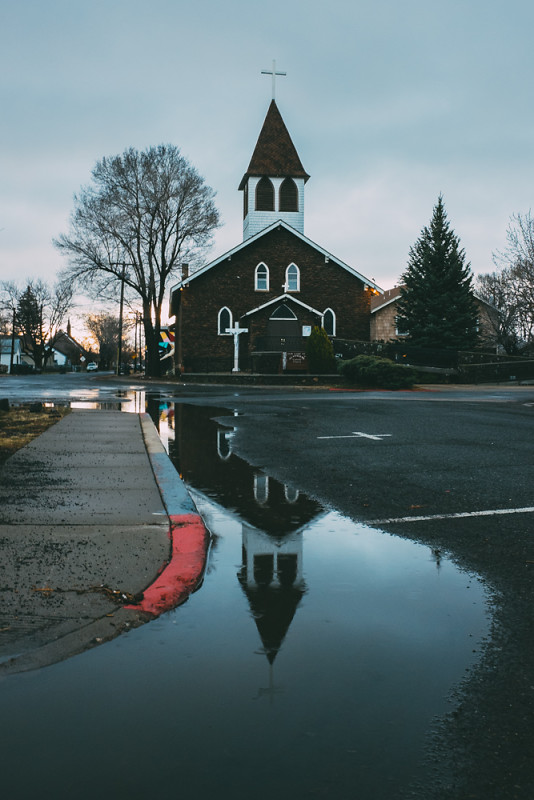
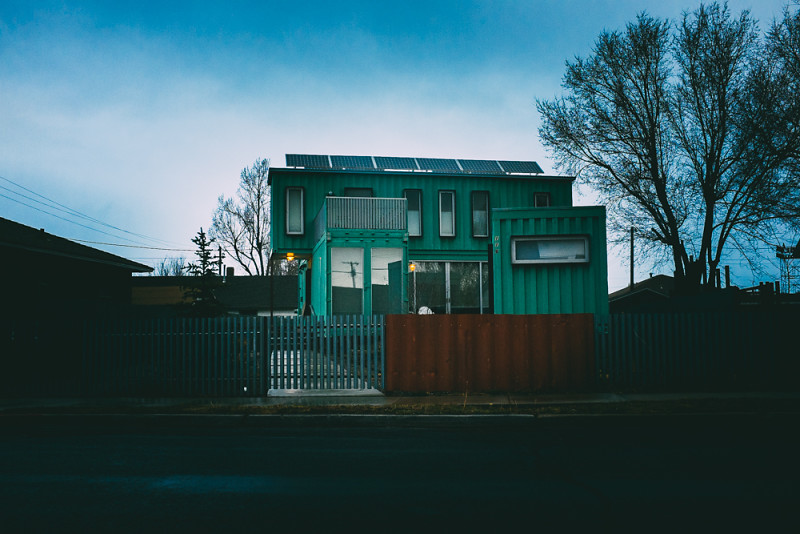
Downtown has a lot of streets at odd angles to one another, old gravel lots, and a mix of new and old construction — churches next door to motels next door to restaurants, and almost everywhere a view of the train tracks or buildings that once housed businesses related to the trains. The neighborhoods are home to small, old homes in different stages of repair, depending on how long they have served as rental housing for NAU students. I enjoy the mix of home construction, some of which shows a strong southwestern influence with Adobe and tile, while other homes are in the mountain town style of clapboard, shingles, corrugated metals. There’s one fascinating house downtown built out of converted shipping containers. Last night, there were some fun puddles to be found, shining up the late evening light.

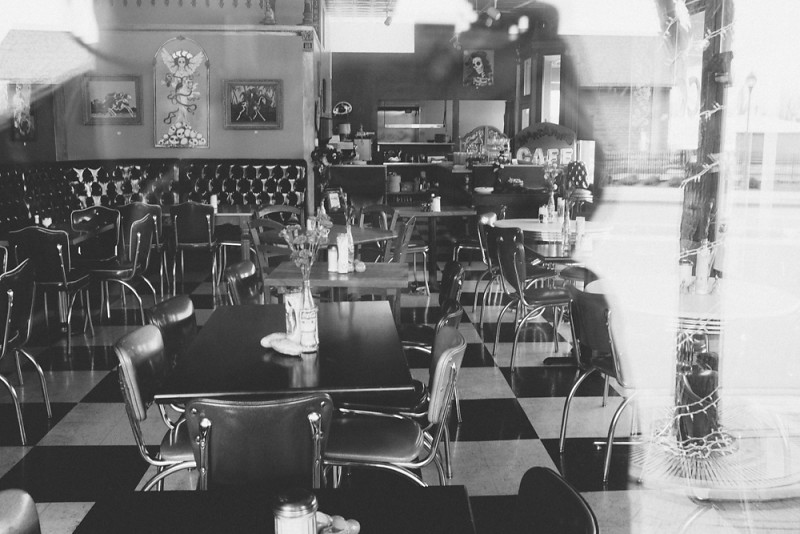
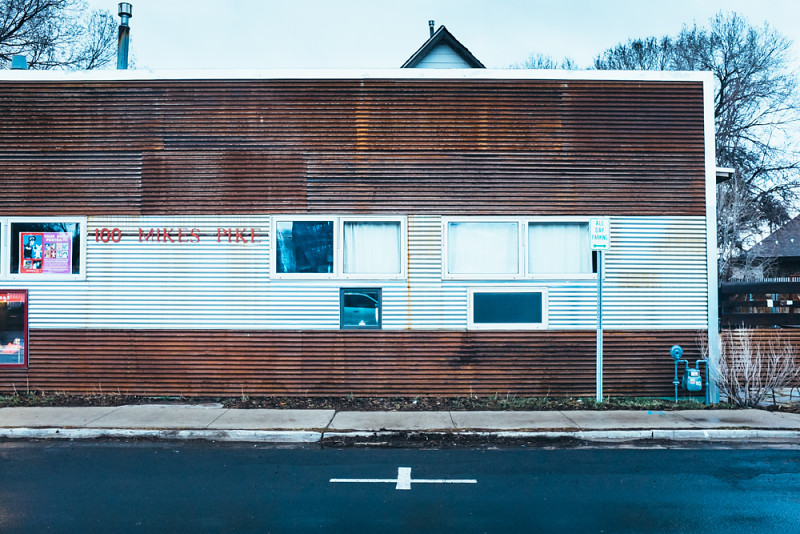
I made it back to the car just as the storm really opened up again, cold hands flexing in the car after holding the camera in the wind and incipient rain — turning to slush and snow as the temperature dropped in the last block that I pulled up my hood, stuffed the camera back in the bag and made for the car.
A VSCO note
My photo walk was in part inspired by the need to get out of the house, and in part by Michael Laroque’s “Addicted” — VSCO Film 05 writeup. I really love Michael’s photography, and his discussion of Film 05 (I have Film 04 and Film 02, already) prompted me to pick it up after hedging for a few days — do I really need it?, I wondered. Michael knows that the point of these preset collections isn’t to make every photo look the same, but to find some inspiration in the looks they offer:
But it does mean I get to play with a new toolbox and with each and every release, some of the new emulations have triggered ideas, or found their way into my workflow in some shape or form. In many ways it’s like buying a great photography book… It inspires and shakes the status quo even if you don’t end up copying everything you’ve seen.
So, no, I don’t need it, and as a hobbyist I’m not going to make any money or anything. But I like them, and as I’ve mentioned previously, the film packs don’t take me back to my golden days of shooting film (though they do make me think about how long I spent shooting 35mm film in an automatic camera without thinking a moment about it); they help me find moods or textures or ideas that I might not have otherwise. So as someone who just enjoys this, it’s easily worth the price.
Adventures on the Isle of Skye --- An impromptu trip of a lifetime. ▹
There are some really lovely landscape photos in this Storehouse post about visiting Isle of Skye. What a beautiful place.
[John Foreman on Machine Learning, Privacy, and Humanity ▹](http://www.john-foreman.com/1/post/2014/02/data-privacy-machine-learning-and-the-destruction-of-mysterious-humanity.html)
John Foreman is the data scientist at Mailchimp. His post about machine learning and the meaning of human agency is deep, in all ways — extremely knowledgable, expansive in scope, and intensely human. Recently I sketched some extremely un-refined thoughts about becoming part of the big data machine through passive data collection; John knows how to think through this right and sharp.
(Don’t miss the precursor piece, either: You don’t want your privacy: Disney and the Meat Space Data Race. Mickey Knows everything.)
Quantified Selfies
Seth Clifford is on to something with his thoughts about Fitbit fatigue.
For a solid year it never left my side, unless I forgot it (rare), and then I was nearly inconsolable (all those lost steps!). Over time, something changed though; I was more concerned with collecting the data and having it than actually using it. It became a weird anxiety-provoking moment (pat pocket-ok it’s there-whew) that I experienced a few times a day.
I’ve had my own fitbit for a little over a year, too, and while I’ve done the pocket-pat once or twice a day myself, once the fitbit became a part of my routine it has not been much of a stressor. But I’ve never changed the default goal step number of 10,000; never tracked food or water, except at the very beginning; never built a big network of fellow social-steppers. I did, however, have a lovely fun time hooking its data into my Slogger feed and building a nicer sleep visualization than the built-in one. At the same time, however, I don’t know if it’s providing me a lot of value.
Like Seth, I listened to the recent couple of episodes of Back to Work on self-quantification and how it “can goose your mindfulness.” I really enjoy those kinds of discussions; like many data- and technology-oriented interneteers I get a little bit buzzed just thinking about the array of ways we have to gain insight into behavior and habits (As Seth says, “Numbers! Graphs! Yay!”). So in addition to Fitbit, I use Runkeeper to track my workouts, again using Slogger as the collection method to archive that data along with my App.net posts and last.fm listens, as well. All of this is partly just because, well, I can: I get a little bit of basic satisfaction doing these little integrations, tuning the tools and such.
But here’s the problem with collecting all of this stuff: Unless I’m asking questions of that data, it’s mostly just taking up space — cognitive and disk — instead of increasing my self-awareness or mindfulness. The ease of passively quantifying ourselves lets us accumulate data without setting goals or interrogating its meaning to us. At best, that means we get very little value from it; at worst, in the case of a service like Runkeeper or Fitbit we’re feeding information into a big data aggregator whose own monetization intentions are rather less ambiguous1.
Yet the impulse to learn more about myself remains compelling; this is one reason why, despite a healthy sense of skepticism about the quantified self — or at least the un-analyzed quantified self — I’m really interested in Reporter. Made partly by Nicholas Felton, famous for his annual reports and creator of Daytum, Reporter pops up a notification on the iPhone at several random times during the day to ask a handful of questions: What are you doing, where are you, who are you with, etc. While it does produce some numeric data (how many coffees did you have today?) and other information that may be expressed categorically or on a scale (how well did you sleep?), it’s really excellent at qualitative recording, and has a great flexibility for creating new questions. It can ask additional questions when you go to sleep or wake up, too.
Reporter can ask as many or as few questions as you like. The first question I added to Reporter was “Are you engaged in what you’re doing?” This is a prompt for me to think about how well I spend my time in a very general way. Sure, later I could build cross-tabs of that response with where I was or what I was doing (working, not working, etc), but for now it’s just a way to remind me to be thoughtful. The Reporter: Unofficial Survey Question Repository is a great resource for interesting items that users are adding to their surveys, and I love that a lot of them are qualitative and seeking personal insight rather than numbers:
By default, everything you tell Reporter is entirely private, stored on your device. You can optionally export to Dropbox, but there’s no service rolling it all up. So far, I really am happy with the experience and am looking forward to continuing to use it to tell myself a little bit more about myself.
Because It's There
I first cribbed this story about a Minecraft player walking to the “end of the world” because there’s something kind of wonderful about that adventure, based as it is on a wondering about just what does happen at the edge of a procedurally-generated landscape. The so-called Far Lands exist because of the way the Minecraft map is generated and stored :
They’re not infinite, but there’s no hard limit either. It’ll just get buggier and buggier the further out you are. Terrain is generated, saved and loaded, and (kind of) rendered in chunks of 16 * 16 * 128 blocks. These chunks have an offset value that is a 32 bit integer roughly in the range negative two billion to positive two billion. If you go outside that range (about 25% of the distance from where you are now to the sun), loading and saving chunks will start overwriting old chunks. At a 16/th of that distance, things that use integers for block positions, such as using items and pathfinding, will start overflowing and acting weird.
So not only will the world begin to look strange, but acting within it will be strange — the further you go, the less reliable the very rules will get.
Felix Gilman’s The Half-Made World is another take on a similarly allegorical but less mathematically-built premise, in which the western edge of the world has yet to be built and is continuously contested by violently warring metaphors.
There are some predictably snarky comments to the story about gamers needing to go outside in the real world once in a while and how disappointed Edmund Hillary must be, but despite the haughty criticism of Strangers on the Internet, Kurt Mac has turned his Far Lands trek into a full-time job in addition to a funnel of charitable donations for Child’s Play, via ads/merch on his web site and youtube channel, where he broadcasts regular episodes of the adventure.
His relatively recent rise to success (since early 2011) is in contrast to the trajectory of many more YouTube entrepreneurs who are being squeezed by rapidly dropping ad rates1 and less generous sponsorship opportunities. Having aggressively encouraged producers and with content volume now exploding, Google can’t maintain the high ad rates:
Some executives of media companies that post videos to YouTube and other sites make basically the same point: YouTube is uploading videos so quickly that it can’t sell enough ads to fill all the potential spaces. It is especially lagging, they say, in selling ads to its two fastest-growing audiences: those coming through mobile devices and those overseas.
A DIY Let’s Play channel posting weekly is ridiculously low-cost against the high-value programming that Google and YouTube are pushing to create increased advertiser interest, and so much easier to be profitable — compare to the film equipment, writers, editors and other staff, and sets required for productions that more closely mirror TV. And I don’t know about US compared to overseas, but the heavy gamer audience that is feeding views and revenue to Far Lands or Bust may be particularly unlikely to be going mobile because they watch while gaming or coding. 2 So while it’s kind of amazing that a long walk in Minecraft ever had a chance at becoming a business, that particular niche — low-cost, dedicated consumer base, desktop-based — may be slightly more sustainable than big, fancy ventures. Right now, it’s hard not to wonder if Google killed the goose by building shiny production facilities and pushing expensive content when so many home-studio enthusiasts were already making stuff that people wanted to see — and that advertisers wanted to get in on.
Roll your own Mac
Nic Lindh writes an entertaining and informative story about building his Hackintosh:
The complexity is also high. Remember, you’re dealing with something completely unsupported that is by its very nature complicated. You’re picking parts, tweaking BIOS settings, installing strange system extensions, and groveling through more-or-less-illiterate testosterone-soaked forum discussions trying to pick up clues on how to fix something that’s not working. The learning curve is steep.
Every once in a while I think about building one of these myself, but I don’t have long weekends to go get lost in much anymore. I think I like reading about it more than I would like the never-quite-done fiddling, despite the on-paper cost savings for a high-power Mac.
Being a Better Reader
In Songs About Songs Robert McGinley Myers nicely describes some of the tension in blogging between producing one’s own original material and “chattering” as John Roderick called it recently, or deluding ourselves that meta-commentary is more substantial than it may really be. The best reader-writers are doing more than pulling from the massive volume of internet firehose stuff, synthesizing themes and ideas and presenting it back to their own readers. Which isn’t to say that kind of synthesis isn’t useful, valuable, and important, but unless it has a perspective of its own, well, it’s just a conduit.
Robert McGinley Myers:
But I’m not sure I would draw such a qualitative distinction between primary and secondary source material. Songs are not empirically better than linked list blog posts. I’d rather read a brief but beautifully crafted post on Kottke or Daring Fireball than listen to a lot of the songs currently on the radio.
Yes, but I think the differentiating factor is that a carefully observed link post at Kottke and Daring Fireball is also part of a portfolio. Readers know that Jason and John have a perspective that they bring to what they share — and what they note about it — because those smaller shared bits are part of their long writing histories, even when the added comment is brief (like a “Finally.” from Gruber). But let’s be fair to pop music, where an observer-fan might fit this year’s hit albums into a trajectory of musical themes or innovations, and therefore find much more depth and meaning to enjoy than Robert or I will.1
This is actually one reason I really enjoy reading reviews; I’ll never play, watch, read, or listen to most of the reviewed works, but I like understanding what deep subject matter experts/enthusiasts find interesting — or not — in their topics.
This line of thought started with wondering where and how to add value to a conversation about things that interest me or move me somehow. (Why it’s compelling to do this is probably another entire thing that goes back to that ever-since-the-1990s enthusiasm for making stuff online, a stint of being a scholar-blogger, and an ongoing desire — perhaps a desperate one — to do something expressive in a medium that I know a small something about.) So I’ll take as stipulated for now that a good conversation can come from both a) “primary source” (that is, original) material and b) shorter links and sharing that are part of a larger body of work, both of which represent a creative and thoughtful perspective; and then I would make a proposition based on my own dilemma: I’m not a good reader anymore.
Right now my Instapaper Gap (that’s the daily rate at which I actually get to sit down and read over the daily rate at which I accrue things to read) is hovering awfully close to zero. It’s an almost entirely aspirational tool because I’ve developed a terrible habit: I squirrel stuff away partly because I want to read it, but partly because I daydream that I’ll write about it, get engaged in the conversation and interaction and in so doing find something rewarding beyond that which comes from just, simply, reading something good.
I’ll go further: I’m a bad gamer, a decidedly mediocre listener, and an absolutely terrible viewer, because my focus is so torn between enjoying/learning/understanding, on one hand, and meta-level multitasking of all sorts on the other. In my defense, I have a three year-old, work a full-time job, and my resulting time/attention span is bifurcated in all sorts of ways. But come on, would it kill me to re-learn how to focus on things?
So I’m working on being a better reader.2 I’m just reading for its own sake, to appreciate whatever an author wants to make me feel or make me think about. This does not mean being unreflective or passive; rather, it’s letting me enjoy and focus in a different way. The Instapaper gap may not be narrowing, but it’s not approaching zero quite as quickly. And when I feel like there’s something for me to say, the overhead is perhaps a little easier to clear out.
Note: I started this post a couple of weeks ago as a draft and ended up publishing it unfinished and not realizing it. When I realized this was on the front page, I figured it was time to shore up my thinking. If you happened across that half-finished copy, well, thanks for coming back anyway to read some more.
Text Editors Data Update
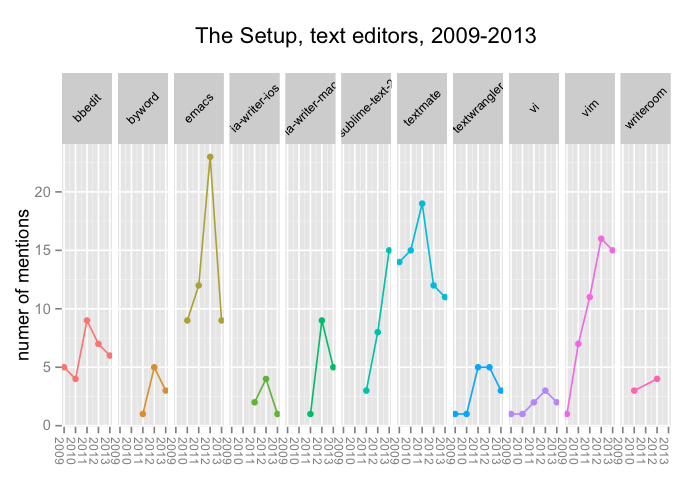
Following up on a skim of text editor data from The Setup last summer, I thought I’d catch up now that the 2013 information is in. It’s been quite a while since I dove deeply into the source data at The Setup, so it’s possible I’m missing new editor trends; I should read up on the interviews again, but meanwhile this is another fun, quick snapshot.
 {:id: .center}
Looks like after its 2012 surge, Emacs dipped steeply, while vim remained high and Sublime Text 2 grew in use (mentions) substantially. Among new, popular tools last year, Editorially has a single mention in the data, and Editorial doesn’t yet show up.
Meanwhile, interviewees at The Setup appear to remain remarkably unsympathetic to Windows Phone devices:
    Mobile Devices:
    ---------------
    iPhones: 		218
    iPads: 		145
    Androids: 		88
    Windows Phone:	1