Pretty Good Hat

Invisible, Inc., and Roguelikes

Three Moves Ahead has had a couple of shows lately that I’ve really enjoyed. First up was their interview with some of the crew from Klei, makers of Invisible, Inc. and previously of Mark of the Ninja. I really loved Mark of the Ninja, and when I heard this interview I couldn’t resist picking up Invisible, Inc., too.

It’s so great: Turn-based stealth that combines the isometric X-COM perspective and some of its combat elements with bits of the turn-by-turn dynamics of Frozen Synapse and the push your luck action of FTL. Which isn’t to say it feels derivative; it just uses some familiar elements in such a great, fun way.

Also, it’s a tiny bit forgiving, at least while you learn the ropes, unlike FTL or Frozen Synapse: On the beginning difficulty level, you have five “rewinds” that you can use to back up to the beginning of the previous turn, and they come in so handy when you misplan, lose two agents in one round, and need to back up and think about What You’ve Learned.

Snow in May

After a very dry winter, we’ve had cold weather and repeated rounds of snow and rain this month, enough that this May looks to go on record as the 10th wettest in Flagstaff weather history. I complain a little, because I want to ride my bike and sit on the porch, but we do need the moisture. It makes for a spectacular scene, too. Also, I love the view from my twelve-minute commute. (This is when I don’t ride my bike to work.)

Wunderlist API + Alfred = Cool

Wunderlist is a super application and my wife and I use it for almost everything list-like. But I don’t love adding items to lists using the web app’s interface: I want something non-clicky that I can capture items to from anywhere. So I was quite happy to find that they offer a developer API!

Getting a developer account and openauth key for your own sample application is easy, and with a little tinkering I put together a pair of Alfred workflows for adding items to my inbox and grocery lists.
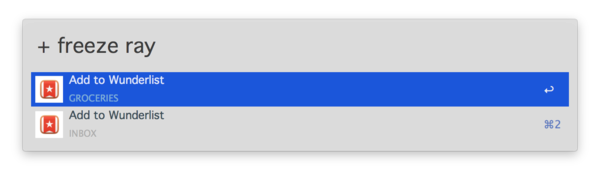
Add to Wunderlist in Alfred - screenshot

I’d like to improve on the workflow so that it can call an external config file or shell variable instead of having the auth key hardcoded in the workflow as it is now; that will let me share the thing as a package, too. Meanwhile, if you want to try this out, you’ll need your own developer account and sample application with authorization key from Wunderlist. Then you can make an Alfred workflow that runs the following in bash (insert your own CLIENTKEY, ACCESSTOKEN, and LISTID):

curl -s -H 'Content-Type: application/json' -H 'X-Client-ID: CLIENTKEY' -H 'X-Access-Token: ACCESSTOKEN' -d '{"title":"{query}","list_id":LISTID}' -X POST 'https://a.wunderlist.com/api/v1/tasks'

Pretty sweet.

Jess Zimmerman stole a pen from Douglas Adams' grave

She writes about Adams on the 14th anniversary of his death:

I was honest about one thing, at least: I don’t use that pen for anything besides fiction. I’m not the type of person who collects memorabilia: I lent my signed Mostly Harmless to a friend in high school and never got it back and never really minded. My copies of most of his books are in shambles, read to shreds. But I’m precious about that pen. It won’t be used to write a shopping list while I’m alive. The artifacts of reading are comfortable, disposable; the artifacts of writing are amulets and alchemist’s tools.

Being a Man in Tech

Or, trying to be a better man in tech

Notes prompted in part by the scale of inequality offline and abuse online, most specifically against women in technology. I have no illusion that my writing at this personal site has impact, influence, but it’s important to me to write some of this down and toss a small rock in an already-swirling rapid.

  • My race and gender do not complicate my position in my job and the cultural things I spend my time doing, but gender and other statuses profoundly shape the experience of others. Having listened to and read those experiences, I am more aware of my charmed life as a White Guy in Tech, conscientious about the opportunities I might help make real or unintentionally block and why it matters that I try to help: because diversity where I work makes that work better, and because it helps to improve — perhaps by an incremental margin but a difference all the same, if successful — the lives of people facing structural and deeply-entrenched inequality. This by itself is an outcome that I value.

  • My own experience is richer for having a broader perspective on those of others.

    • I am better for it, and I’m trying to say that in a way that sounds as least selfish as possible: having a broader perspective is enriching, not limiting; it is not zero sum, it does not “take away” what is special about me or my life, and it makes more room for others.
    • I acknowledge that I am lucky in many ways that so many others are not: I have a good job, one that I like and which is rewarding; I have a home and supportive family; stability; safety. When I do something online (or in the office, for that matter) that activity is not marked by my race and gender the way it is for many.
    • Just as I want to be able to express myself, so should I help those around me. This is restricted in environments marked by marginalization, where we are uneasy being open and expressive.
  • I wrestle with staying out of the way vs joining some conversations because I recognize that these spaces are fraught with co-optation, risk, and safety concerns – emotional and physical.

  • Having spent a lot of time getting advanced degrees in a field in which structural inequality is a core tenet underlaid with decades of quantitative findings, the facts of this inequality are something I have long understood. Yet I am still struck when I see it enacted by men so viciously mocking the difficulties of women in technology and culture, so quick to use violent imagery and ugly slurs against those who are outspoken and visible.

    • This is also one reason the “everybody is awful on the internet” argument is so tremendously hollow. This gets trotted out frequently in defense of awful online treatment of women (and all marginalized groups). At Not Your Mama’s Gamer, Alisha Karabinus takes apart this “notion that everyone gets threatened in gaming”:

    We cannot conflate targeted harassment of a woman (or all women) with general incivility in online discourse because not only are the bases not the same, but the impacts, too, are vastly different. In other words, we’re not talking about hurt feelings or trash talk here. We’re talking about pervasive, damaging behaviors that can impact an entire culture, and behaviors we rarely address or speak about honestly.

  • Another often-used justification is that all people in geek culture feel abused, marginalized and left out. Not only does this reflect an obvious and staggering lack of empathy (justifying being abusive and awful by claiming to have at one point felt bad yourself), but it’s a weird historical artifact at a time when gaming and once-niche entertainment are multi-billion-dollar industries, and STEM training/jobs are sucking all the air out of most other kinds of education and work. Geeks are inheriting the world, gang, and it’s high time that those of us who had a hard time in school because we were interested in video games|comics|programming|computers understand that so did most everybody else, albeit for different reasons, and so many have it so much worse.

    • I have stinging memories of not feeling like I belong,1 and I am fortunate to have found a community of like-minded BBS nerds (men and women) at a key point in my growing up.
    • Yet: However difficult my experience, it critically is fundamentally different from that of someone truly marginalized by institutional sexism, racism, or other discriminations.
  • I think about things that I can do to change this space positively. I can be conscientious about making opportunities and including voices. I have some opportunity to do that where I work, and I try to do so, conscientious that my impact is greater among those I know than in a twitter conversation. Meanwhile I keep listening, though I know that’s not enough. I’m taking seriously the admonition from that Justice Points episode about amplifying good rather than boosting the conflict.

Better voices

In addition to the links noted above, here are a few starting points for more, from people who are better at this than I, and a couple of recent points of research and culture war intersections that are illustrative of what’s going on.

  • Isometric: This post started out being called “How Isometric Made Me a Better Person” but that seemed too naval-gazing even for a blog post. I got to know Steve Lubitz and Brianna Wu casually back when we all hung out on App.net, and have had a great time as well as learned a lot from everybody on the show. It’s a gateway to a lot more than games; this post and the voices on these issues that I have found stem in large part from listening to it.
  • The Cool Gamer Girlfriend and Permission to Try by Maddy Myers (and a related conversation on Isometric #50)
  • Model View Culture is producing a lot of sharp work on these topics from a bunch of points of view: disability, hacker culture, feminism, race, more.
  • Shanley’s My Statement is a scary illustration of just how bad it can be.
    • It is only one of many, many such stories, from all industries.
  • Not Your Mama’s Gamer, a collective of authors behind such things as the #yesIplay tag and a ton of interesting writing (making super podcast, too).
  • How conservatives took over sci-fi’s most prestigious award, a glimpse into the current culture war that’s particularly emblematic of how regressive and fundamentally politically conservative so much of these attacks are.
  • The 5 Biases Pushing Women Out of STEM, because it’s not as simple as a “pipeline problem.”
  • How Hollywood Keeps out Women, because it’s not as simple as a “tech industry problem.”
  • Mel Chua, On the diversity-readiness of STEM environments: “But I have always wondered what I might have grown up into, if I had learned STEM in an environment that was ready for me — without me having to fix it first.”

  1. Hell, I still struggle with this, but I’m mature enough to know I’m not the only one. ↩︎

Keeping the Web

I really like the thinking that Joel Dueck is spinning up around privacy and facilitating payments to make building stuff online economically viable without ads. He proposes some legal and architectural tools, but notes that:

Focusing on the nuts and bolts of the web itself, looking for technical solutions, is not going to be enough to counteract these broader trends. And as I’ve said before, simply appealing to people to change their personal habits of internet usage is insufficient and ineffective. What is needed is a principled re-adjustment of the entire playing field — a political solution to a political problem.

Elsewhere, he remarks that if the economics of blogging do collapse1, he will “feel as though we lost something valuable — a truly democratic chance for people to sustain their lives through the pursuit of literacy and self-expression.” I thought about this same thing this morning, and I contemplated the worth of continuing to write and post here. The “community”, such as it was, of bloggers and readers, is much changed from when I started posting to my old home blog, way back in the pre-social media days. But here I am, all the same, tapping away. For those of us who were into this before services ate everything, it’s kind of a hard habit to break.


  1. see e.g., Kottke on Dooce retiring ↩︎

Three Moves Ahead on 4X Games

I really like this episode of Three Moves Ahead on the 4X Genre. I haven’t played a ton of 4X games myself (my most recent experience being a whole bunch of Endless Legend a few months ago), so I’m only passingly familiar with most of the games they chat about (even Civ! I know, I know!), but this is still a really accessible conversation that touches on a lot of interesting elements of these games: Balance between the different phases of the game, the rare expertise required to build 4X mechanics, and the difficulty of innovating in storytelling within these games. They also talk about the often uncomfortable assumptions made in most 4X games, of an unspoiled world ready for exploitation and civilizing in the service of a conqueror (reflecting on the problematic “explore, exploit, expand, exterminate” label, too), and imagine a game in this style that could really explore things like postcolonial conflict.

It’s a fun and wide-ranging discussion and I’m looking forward to listening to more from Three Moves Ahead and Idle Thumbs.

Browser Tab Roundup

The One-Minute Test

Via Jeremy Keith, a method of wrapping up a meeting by asking for concrete reactions in just a minute:

  1. What was the big idea? (What was the most important thing you heard at the meeting?)
  1. What was your big surprise? (What was the thing you saw or heard that surprised you the most?)
  2. What’s your big question? (What’s the biggest unanswered question you have at this time?)

I’ve been in meetings that ended in a similar way and found it to be a really positive way to conclude. One spin on that final question that I have liked is to ask “who will you share this question with” or “where do you go next with this idea” — It’s very satisfying to generate a specific kind of next step that’s social and/or active, and it encourages a much more engaged conclusion that might not otherwise come out of some meetings.

The Spark File

Steven Johnson on keeping a bin of ideas, “hunches” and snippets of writing:

But this kind of inventory doesn’t quite convey the most interesting part of the experience, which is the feeling of reading through your own words describing new ideas as they are occurring to you for the first time. In a funny way, it feels a bit like you are brainstorming with past versions of yourself. You see your past self groping for an idea that now seems completely obvious five years later.

I get the same experience from occasionally going back to the scattered output of my years of blogging and notes-file-keeping: at various times using web sites, planner-mode, org-mode, Moleskines, Field Notes, and now here. What Steven has probably done more smartly is keep most of that in one place. In that time I’ve been a number of things, or at least two, having moved out of academics into the work I’m doing now.

Learning Vim in 2014

God help me, I’m learning another text editor. I’m not sure why; seemed like it could be interesting or engaging, which it is. I think it all started when vim was the available default over at tilde.club when I was heavily involved there. Maybe it’s a way to make up for having ditched emacs at work for now?

Ben McCormick’s excellent series is an introduction to the nuts and bolts as well as the philosophy – see his Vim as Art in particular on that score. I’m exploring the whole thing repeatedly as I make my way. I idly trolled on Twitter how learning Vim was like turning your text editor into an RTS. Now I think I really like that idea and the way it makes me think systematically about what I want to do with my editor. It’s cool.

Newsletter Serendipity

It’s a nice bit of serendipity that I caught up with this piece on newsletters and the new market for specialized writing by Glenn Fleishman on the same day that stellar issues of two favorite subscription newsletters arrived in my inbox: 6 49: Focus Past Infinity by Charlie Loyd, and Metafoundry 30: Confusion Matrices by Deb Chachra.

And as it happens they’re both writing insightful things about clothes and their tight ties to our social and economic worlds: Charlie thinks a bit about supply chains; Deb, the pervasive rules that profoundly shape the meanings of women’s choices of clothing.